Sustainable Development Goals in Ghana: Serene Future’s Role
Serene Future Foundation’s Contribution to the Sustainable Development Goals
The Sustainable Development Goals in Ghana become meaningful when global ambitions translate into changes people can experience in their communities. Serene Future Foundation, a nonprofit foundation in Ghana, works across clean water and WASH, health and dignity, climate action and clean energy, and youth skills development.
How Does Serene Future Foundation Contribute to the Sustainable Development Goals in Ghana?
Serene Future Foundation contributes to priorities connected to the Sustainable Development Goals in Ghana by developing community-centered solutions around clean water, health, education, gender dignity, clean energy, climate resilience, youth skills and partnership. Its approach connects practical local challenges with sustainable action, community ownership and measurable indicators rather than treating development goals as abstract commitments.
Which SDGs Align With the Foundation’s Work?
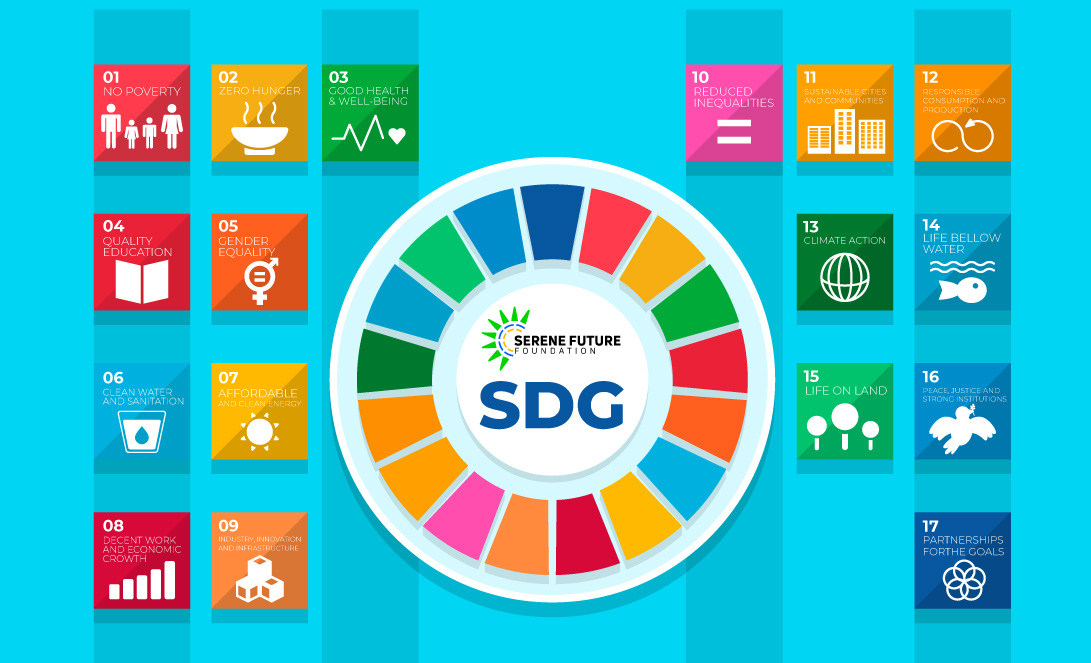
The Foundation’s four focus areas naturally connect with several SDGs. This is a thematic alignment, not a claim of formal United Nations affiliation.
| Foundation focus | Related SDGs | Practical contribution |
|---|---|---|
| Water Access & WASH | SDG 3, SDG 6 | Boreholes, handwashing, hygiene education and water maintenance |
| Women, Girls & Children | SDG 3, SDG 5 | Menstrual health, dignity support and maternal and child health awareness |
| Climate & Clean Energy | SDG 7, SDG 12, SDG 13 | Solar solutions, recycling, tree growing and climate education |
| Youth Skills & Future Readiness | SDG 4, SDG 8 | Digital skills, soft skills, entrepreneurship and career readiness |
| Partnership & Community Ownership | SDG 17 | Collaboration with communities, donors, institutions and volunteers |
The Foundation’s programme framework includes borehole development and rehabilitation, menstrual health education, preventive health awareness, recycling, environmental clubs, solar support, digital literacy, leadership and career readiness.
Why Must Ghana Treat the SDGs as Community Development Goals?
A goal written in an international framework matters most when a family can access safer water, a girl can manage menstruation with dignity, a young person develops employable skills, or a community becomes better prepared for environmental pressures.
That is why local implementation matters.
A stronger SDG-focused community intervention should:
- begin with community listening and needs assessment;
- connect infrastructure with education and behaviour change;
- establish realistic indicators for monitoring;
- involve local people in implementation and maintenance;
- document progress transparently; and
- create a sustainability plan beyond the initial funding period.
Serene Future Foundation’s model is built around listening, acting, partnering, measuring and sustaining, with community ownership forming an important part of how projects are intended to create longer-term value.
What Could Practical SDG Action Look Like?
A typical SDG 6 project may combine a borehole with water testing, hygiene education, school handwashing facilities and a community maintenance committee. A school programme supporting SDGs 3 and 5 may combine menstrual health education, dignity support, teacher engagement and conversations with parents or community stakeholders.
A stronger SDG 13 intervention may include environmental clubs, tree growing, recycling education and community cleanups, while SDGs 4 and 8 can be advanced through digital literacy, communication, entrepreneurship, mentorship and career readiness. When supported well, these interventions can move from one-time activities into lasting community habits.
How Can Donors and Partners Support SDG-Aligned Projects in Ghana?
Donors, CSR teams, ESG departments, foundations, churches, diaspora groups, universities, NGOs and volunteers can support project design, funding, technical expertise, equipment, training and monitoring.
Serene Future Foundation aims to measure relevant indicators such as people reached through water projects, girls supported through menstrual health education, youth trained, trees planted and monitored, clean energy solutions provided and partners engaged. These are intended indicators, not claims of completed results.
Turning Global Goals Into Local Action
The Sustainable Development Goals will ultimately be judged not only by commitments, but by whether development reaches people in meaningful ways. Serene Future Foundation is positioned to help connect global development priorities with practical community realities in Ghana through dignity, local ownership, partnership and sustainability.
Partner with Serene Future Foundation to turn the Sustainable Development Goals into practical community action. Donors, grantmakers, CSR and ESG teams, development partners and philanthropists can support clean water, health, climate action, clean energy and youth skills projects in Ghana. Contact us at partner@serenefuture.org to explore partnership and funding opportunities.
Frequently Asked Questions
Which Sustainable Development Goals in Ghana align with Serene Future Foundation?
The Foundation’s focus areas align particularly with SDGs 3, 4, 5, 6, 7, 8, 12, 13 and 17.
How does WASH support the SDGs?
Water access, hygiene education and sanitation primarily support SDG 6 while also contributing to health, dignity and education outcomes.
How does youth empowerment contribute to sustainable development?
Digital skills, soft skills, leadership and career readiness can strengthen education, employability, entrepreneurship and community participation.
Can companies fund SDG-aligned projects in Ghana?
Yes. CSR and ESG partners can support practical projects in WASH, health, climate action, clean energy and youth development.
Is Serene Future Foundation affiliated with the United Nations?
No formal UN affiliation is claimed here. The Foundation’s programmes are described as aligned with relevant SDG themes and priorities.