
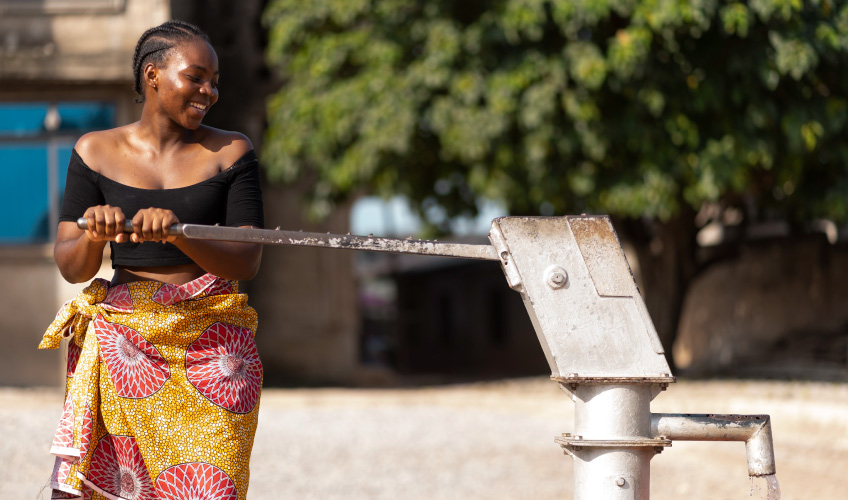
Borehole Projects in Ghana: How Clean Water Restores Health and Dignity to Many Lives.
Why Do Borehole Projects in Ghana Matter?
Borehole projects in Ghana provide communities with safer and more reliable access to water for drinking, cooking, washing, and hygiene. Serene Future Foundation plans to support the construction of 50 boreholes across Ghana, helping communities reduce water-related risks, protect dignity and create a stronger foundation for health, education and local development.
Clean water is not simply a household convenience. It shapes health, school participation, productivity, safety, and dignity.
In communities where safe water is difficult to access, families may spend significant time searching for water before the day can properly begin. Children can arrive at school late or tired. Women and girls may carry a disproportionate share of the burden. Households may also depend on water sources that are unreliable or unsuitable for daily use.
Serene Future Foundation is a nonprofit foundation in Ghana working to build healthier, cleaner, skilled, and climate-resilient communities. As part of its Water Access and WASH focus area, the foundation plans to mobilize companies, donors, institutions, diaspora groups and individuals to help deliver 50 borehole projects in Ghana.
This is an ambitious goal, but it is also a practical one. Each completed borehole can become a source of health, relief, opportunity and dignity for the community it serves.
How Does a Borehole Improve Community Health?
Safe and reliable water supports nearly every part of community wellbeing. A functioning borehole can help households:
- Access water closer to home
- Improve handwashing and personal hygiene
- Prepare food in safer conditions
- Keep homes and community spaces cleaner
- Reduce dependence on unsafe or unreliable sources
- Strengthen sanitation and hygiene education
- Support schools, clinics and public facilities
The value of a borehole increases when infrastructure is combined with hygiene education, water-quality checks, maintenance planning and community ownership. A borehole should therefore not be treated as an isolated construction project. It should form part of a broader water, sanitation and hygiene strategy.
How Does Clean Water Restore Dignity?
Dignity is often discussed as an abstract idea, but access to water makes it practical. Clean water allows a child to attend school feeling clean and confident. It gives a mother a more reliable way to prepare food and care for her family. It can reduce the time women and girls spend walking long distances to collect water. It supports menstrual hygiene, household cleanliness and safer care for young children.
When water is inaccessible, people may be forced to make painful daily choices between distance, safety, time and quality. A community borehole helps replace those choices with greater stability.
Clean water is the beginning of dignity, health and opportunity.
Why Must Ghana Treat Water Access as a Community Development Issue?
Water affects more than health. It influences education, livelihoods, gender equality, environmental resilience and local economic activity.
| Water-access challenge | Everyday community impact | Practical response |
|---|---|---|
| Long distance to water sources | Lost time for school, work and family care | Construct a borehole closer to households |
| Unreliable water supply | Disrupted cooking, hygiene and daily routines | Develop a dependable community water point |
| Poor-quality water sources | Greater exposure to preventable health risks | Conduct water testing and promote safe storage |
| Weak maintenance systems | Boreholes fall into disrepair | Train local water-management committees |
| Limited hygiene education | Water access does not always improve hygiene behaviour | Add community WASH education |
| Lack of local ownership | Projects become difficult to sustain | Involve leaders and residents from the planning stage |
A stronger project model connects infrastructure with people, behavior, maintenance and accountability.
What Is Serene Future Foundation’s 50-Borehole Plan?
Serene Future Foundation aims to support the construction of 50 boreholes across Ghana through partnerships, sponsorships and community-based implementation. The plan is intended to reach underserved communities, schools and other areas where reliable water access remains a serious challenge.
A typical borehole project may include:
- Community consultation and needs assessment
- Site identification and technical assessment
- Hydrogeological survey where required
- Borehole drilling and construction
- Pump installation and platform development
- Water-quality testing
- Community WASH and safe-storage education
- Formation or training of a local water committee
- Project documentation and partner reporting
- Follow-up monitoring and maintenance planning
The foundation’s goal is not simply to count completed structures. It is to help establish water systems that communities understand, value and can help protect.
What Makes a Borehole Project Sustainable?
A borehole becomes sustainable when the community is prepared to manage it after the launch ceremony.
An effective project should include:
- Community participation before construction
- Clear responsibility for routine maintenance
- Local training on reporting faults
- Safe-water storage education
- Hygiene and sanitation awareness
- Transparent management arrangements
- Regular monitoring
- A plan for repairs and replacement parts
Community ownership does not mean shifting every responsibility onto residents. It means ensuring that people understand the project, have a voice in its operation and know how to respond when problems arise. When supported well, a borehole can move from a one-time intervention into a lasting community asset.
Which Sustainable Development Goals Can Borehole Projects Support?
Borehole projects in Ghana can contribute to several connected development priorities.
| Sustainable Development Goal | Project connection |
| SDG 3: Good Health and Well-Being | Supports safer water, hygiene and healthier daily living |
| SDG 4: Quality Education | Helps reduce water-related disruption to school participation |
| SDG 5: Gender Equality | Can reduce the water-collection burden often carried by women and girls |
| SDG 6: Clean Water and Sanitation | Directly improves access to safe and reliable water |
| SDG 10: Reduced Inequalities | Supports communities with limited access to essential infrastructure |
| SDG 17: Partnerships for the Goals | Brings companies, donors, institutions and communities together |
Partners should select the SDGs that genuinely match the activities and intended outcomes of each project.
How Can Companies Support the 50-Borehole Goal?
Companies can integrate a borehole project into their CSR, ESG, sustainability or employee-engagement strategy.
A corporate partner may:
- Sponsor one complete borehole
- Support several boreholes across selected communities
- Co-fund a borehole with another organization
- Provide drilling, engineering or water-testing expertise
- Support hygiene and sanitation education
- Fund community maintenance training
- Provide branded educational materials
- Engage employees in fundraising or awareness activities
- Sponsor monitoring, documentation and reporting
For companies, this creates a practical pathway to connect social investment with SDG 6, community health, stakeholder engagement and measurable local impact.
A professional partnership can be structured around clear deliverables such as:
- Number of boreholes completed
- Number of communities supported
- Estimated number of community users
- Water-quality tests conducted
- Hygiene sessions delivered
- Local committee members trained
- Follow-up visits completed
- Financial and narrative reports submitted
These should be treated as planned indicators until verified through implementation.
How Can Donors and Individuals Help?
Individuals do not need to fund an entire borehole alone to contribute meaningfully. Support may include:
- A one-time donation
- Monthly giving
- A birthday or memorial fundraiser
- Workplace fundraising
- Diaspora community mobilisation
- Professional volunteering
- Equipment or logistics support
- Sponsorship of water-quality testing
- Support for hygiene education
- Introduction to potential corporate partners
Every responsible contribution can help move the 50-borehole plan from aspiration to implementation.
How Can Institutions, Churches and Diaspora Groups Participate?
Institutions can play an important convening role. Churches, schools, universities, professional associations, embassies, development organizations and diaspora groups can:
- Adopt a borehole project
- Mobilise members around a community
- Co-sponsor construction
- Support community engagement
- Provide technical expertise
- Help document and communicate the project
- Promote long-term maintenance
- Connect the foundation with additional partners
A stronger model includes funding, technical support, local participation and transparent reporting.
Why Partner With Serene Future Foundation?
Serene Future Foundation helps connect community needs with practical solutions, local ownership and transparent partnerships.
The foundation’s approach is built around four actions:
We listen. Community voices, schools, families, women, youth and local leaders help shape the intervention.
We act. Projects are designed around practical needs such as clean water, hygiene, health, climate resilience and skills.
We partner. Companies, donors, institutions, volunteers and communities are invited to contribute resources and expertise.
We measure and sustain. The foundation aims to document activities, track appropriate indicators and build local structures that support continuity.
Serene Future Foundation is positioned to be a practical change maker because it treats water access as both an infrastructure priority and a human-development issue.
Frequently Asked Questions
What are borehole projects in Ghana?
Borehole projects involve drilling and installing groundwater systems that provide communities, schools or public facilities with a more reliable source of water.
How do borehole projects improve health?
They can support safer drinking water, better handwashing, improved household hygiene and cleaner food preparation when properly constructed, tested and maintained.
How many boreholes does Serene Future Foundation plan to build?
Serene Future Foundation plans to mobilize support for 50 boreholes across Ghana. This is a future partnership and fundraising target, not a claim of completed construction.
Can a company sponsor one borehole?
Yes. A company may sponsor a complete borehole, co-fund a project or support related components such as testing, WASH education, maintenance training or monitoring.
Can individuals donate toward the 50-borehole plan?
Yes. Individuals may make one-time or recurring donations, organize fundraisers, volunteer professional skills or introduce the foundation to potential partners.
How will Serene Future Foundation support sustainability?
A typical project may include community engagement, hygiene education, local water-management arrangements, maintenance planning, documentation and follow-up monitoring.
Help Us Build 50 Boreholes Across Ghana
Fifty boreholes represent more than fifty pieces of infrastructure. They represent communities with safer water, children with more time for school, women and girls with a reduced daily burden, and families with a stronger foundation for health and dignity.
Serene Future Foundation cannot deliver this vision alone. We are calling on companies, CSR and ESG teams, donors, individuals, churches, schools, institutions, professional groups, diaspora communities and development partners to stand with us.
You can sponsor one borehole, co-fund a project, support water testing, provide technical expertise, mobilize your employees or contribute toward the wider 50-borehole campaign. Together, we can turn this dream into practical, measurable and lasting community impact.
Partner with Serene Future Foundation to help build 50 boreholes across Ghana and restore health, dignity and opportunity, one community at a time.
For partnerships, sponsorship and donor support, contact partner@serenefuture.org.